Crafting card
A crafting card is storage and a 3x3 crafting grid on a card. In any computer you craft with it by hand, in its own tab of the computer’s view. In a robot, programs craft with it too, and move its items to and from the robot’s hand, containers round it, and the world. What the robot breaks goes into its storage.
Facts
| | |
|—|—|
| Type | crafting |
| Where | Any expansion slot of a computer or a Bot Golem |
| /dev | crafting0 (crafting1 the next) |
| Slots | 1 to 9 its grid (rows left to right, top to bottom), 10 to 25 its storage |
| A craft | Half a second (10 ticks) |
| Power | A running CPU’s tick for each craft, and each move |
| Recipe | Crafting table, chip, chest over three copper nuggets over three gold nuggets |
Its slots are on the card itself: take the card out and its items go with it, into another computer or robot. Several cards craft at once: two crafting side by side make twice as much.
In its computer’s view
Each crafting card in a computer gets a tab (a little crafting grid) in the button column right of every view, under the view buttons (and under a golem’s hands), in its screen view too. Click it to open the card, left of the board in the bus order panel’s place, its tab ringed in yellow: its grid, what the grid makes, and its storage, as a crafting table’s. The parts view’s button (the motherboard) brings the bus order back. Take what it makes as from a crafting table (Shift-click makes as many as it can). A tab in the screen view opens the parts view with that card open.
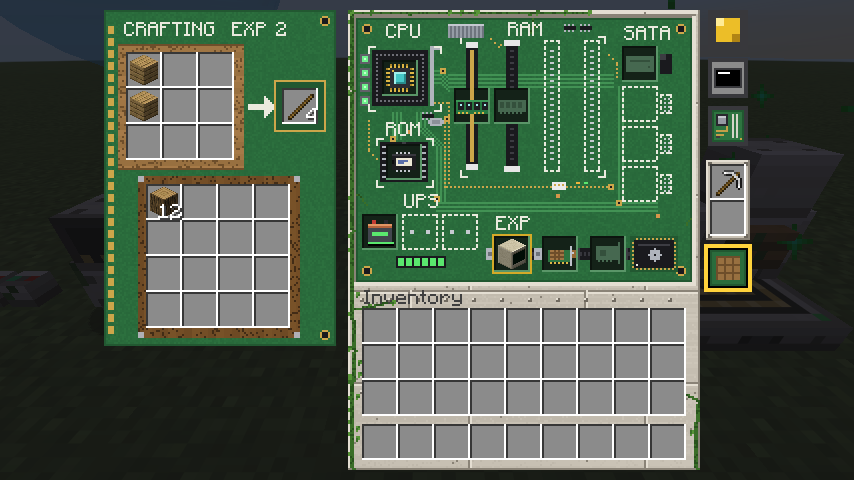 A golem’s crafting card, its tab open: two planks make four sticks.
A golem with a crafting card carries a tiny chest on its back.
Robotics needed
Programs work the card only in a robot: crafting, moving its items and its file need a robot’s
robotics to do the work. In a case every method fails with no robotics available (the card’s
details, with Shift held, say so); its tab still works by hand.
In mcos
Reading /dev/crafting0 lists what its slots hold, a line each, its item and how many:
minecraft:oak_log 12
minecraft:stick 4
A line written drops everything in its storage (not its grid) at a face of the robot: an empty line below it, or a face’s name. A container there is filled first; the rest go into the world. So a golem back from mining empties itself into a hopper or a chest under it in one write:
echo > /dev/crafting0
echo front > /dev/crafting0
Its file’s ioctls are its methods, by name. Its events come as sys.poll’s PRI, and the pull
ioctl takes them.
Methods
Faces are the robot’s own: front, back, left, right, up, down. Where a face is
optional, a container is in front of it and a drop goes below it.
list() → list
What its slots hold: those with something in, each {slot, name, count, ...} (as the robotics
device’s held: damage, maxDamage, label where they apply).
craft([count]) → true
Crafts what its grid makes, count times (1), each taking half a second, what it makes going into
its storage. It answers at once; its event says how it went: crafted (with name and count, how
many it made), or failed and why (no recipe, nothing in its grid, no room: its storage
can’t take what it made, so the craft isn’t made and the grid is as it was). Fails with already
crafting.
move(from, to[, count]) → number
Moves items from one of its slots to another (all, or count): how many went. Fails with slot N
holds something else.
equip(slot) → true
Swaps one of its slots with what the robot holds.
pickup() → number
Picks up the items lying round the robot (within a block and a half) into its storage: how many.
drop([face][, slot[, count]]) → number
Drops items at a face (below, when none is given): all of a slot, or count of it, or with no slot
everything in its storage. A container there is filled first, the rest go into the world. It
answers how many went into the world: what the container took isn’t counted (a hopper below that
takes them later isn’t the robot’s concern).
store([face][, from[, count[, to]]]) → true, 0 or false, remaining; or nil and why
Puts items into the container at a face (in front, when none is given): from slot from (all, or
count), or with none everything in its storage; into the container’s slot to, or where they fit.
One answer says it all: true, 0 when none of it is left (nothing to store too), else false and
how many are left (the container is full). Fails with no container there.
take([face][, from[, count[, to]]]) → number
Takes items from the container at a face (in front, when none is given): from its slot from, or the
first it can; all, or count; into the card’s slot to (its grid’s too, to lay out a recipe), or
where they fit in its storage. How many came.
get() → list
What list gives: its file’s read.
set([face]) → true
Drops everything in its storage at a face (below): its file’s write.
pull() → event or nil
Its oldest event, or nil.
Events
event |
Other fields | When |
|---|---|---|
crafted |
name, count |
the crafts asked for are made |
failed |
why, count (made before it stopped), name |
a craft couldn’t be made; interrupted when its world was saved during it |
Example
Turn the logs in a chest in front of the robot into planks, and put them back:
-- Turn logs from the chest in front of the robot into planks: take a stack of logs into the
-- crafting grid's first slot, craft once a log (four planks each, into the card's storage), and
-- put everything in its storage back into the chest. Each craft takes half a second; the card's
-- event says when they're all done (crafted), or why it stopped (failed: no room, no recipe).
local sys = require("sys")

local GRID_FIRST = 1 -- the grid's top left slot

local card = assert(sys.open("/dev/crafting0"))

-- Waits for the card's next event, and gives it.
local function event()
  while true do
    local got = sys.ioctl(card, "pull")
    if got then
      return got
    end
    sys.poll({[card] = {PRI = true}})
  end
end

local logs = assert(sys.ioctl(card, "take", "front", nil, 64, GRID_FIRST))
if logs == 0 then
  print("no logs in the chest")
  os.exit(1)
end

assert(sys.ioctl(card, "craft", logs))
local done = event()
if done.event ~= "crafted" then
  print("stopped after " .. done.count .. ": " .. done.why)
  os.exit(1)
end

local stored, left = sys.ioctl(card, "store", "front")
if stored then
  print("made " .. done.count .. " " .. done.name .. ", all in the chest")
else
  print("made " .. done.count .. " " .. done.name .. ", " .. left .. " left: the chest is full")
end